Lecture 5: The Rise of Reasoning Models

rlhfbook.com

Nathan Lambert

Course on RLHF and post-training. Chapter 7

Lecture 5: The Rise of Reasoning Models

Overview
  1. Introduction
  2. Key Related Works
  3. Training Overview
Core Training Pipeline
  1. Instruction Tuning
  2. Reward Models
  3. Reinforcement Learning
  4. Reasoning
  5. Direct Alignment
  6. Rejection Sampling
Data & Preferences
  1. What are Preferences
  2. Preference Data
  3. Synthetic Data & CAI
Practical Considerations
  1. Tool Use
  2. Over-optimization
  3. Regularization
  4. Evaluation
  5. Product & Character
Appendices

A. Key Definitions B. Style Benchmarks C. References

Lectures
  1. Overview (Ch. 1-3)
  2. IFT, RM, RS (Ch. 4,5,9)
  3. RL Theory (Ch. 6 pt 1)
  4. RL Practice (Ch. 6 pt 2)
  5. Reasoning (Ch. 7)

From RL to reasoning

Lectures 3-4 covered the core policy gradient RL implementation for language models: PPO, GRPO, loss aggregation, async training, etc.

This lecture: The rise of reasoning models, early techniques specific to reasoning, recapping 2025’s core models, etc.

The LeCun cake

At NeurIPS 2016, Yann LeCun introduced the cake metaphor: predictive / unsupervised learning is the cake, supervised learning is icing, and RL is the cherry.

With modern language models, the analogy is complete:

  • Self-supervised learning on internet data = the bulk of the cake
  • Supervised fine-tuning for instructions = the icing
  • Reinforcement learning (RLHF, then RLVR) = the cherry on top
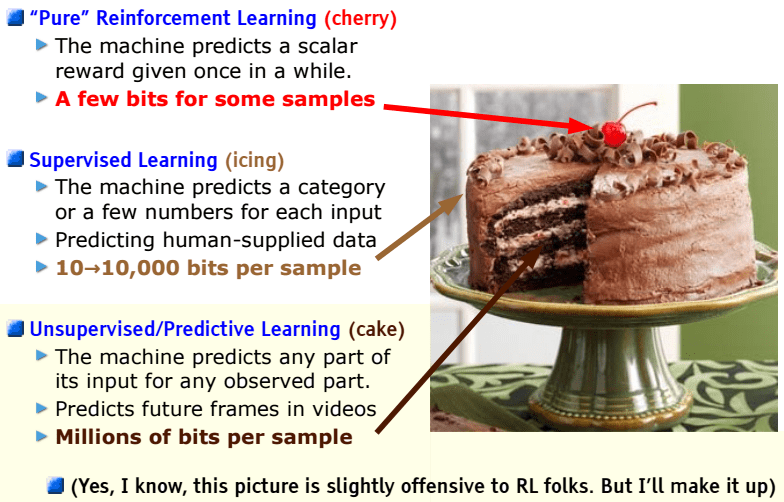
–> With agents, RL may be more than just the cherry in compute, but it’s still the shape of the training loops!

RLHF vs RLVR: How reward changes everything

RLHF – subjective scoring:

Explain opportunity cost in economics.

Scoring requires judging clarity, accuracy, completeness – all learned preferences with no definitive answer.

RLVR – verifiable scoring:

What is the sum of all primes < 20?

extracted_answer == 77 → Reward = 1

Write fib(n) returning the nth Fibonacci number.

assert fib(10) == 55 → All tests pass → Reward = 1

The post-training methods are the same (i.e. same algorithms), but a new set of intuitions for building models.

RLVR opened the door to reasoning models. Now RL training uses mixed rewards, rubrics, and a variety of tools to train useful models. The clean distinction here is pedagogical, but in practice rare.

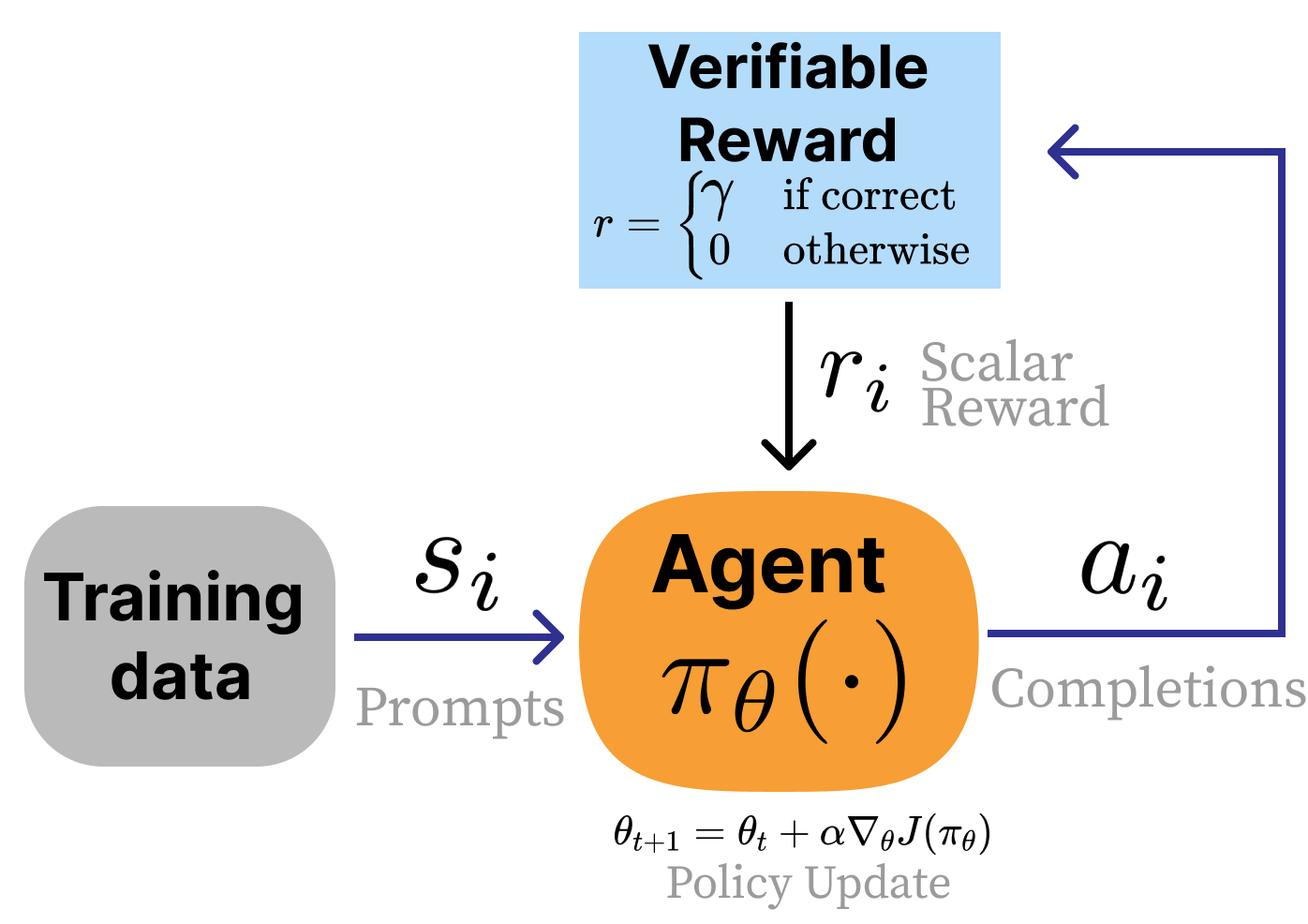
The RLVR feedback loop

RLVR in the form of an RL feedback loop. Instead of a reward model, a verification function scores completions.

Recall: RL training vs inference-time scaling

Train-time compute scaling: more RL training improves the policy.
Test-time compute scaling: more inference compute improves performance.

Recall: What thinking tokens look like

Standard model answers directly:

What is the sum of all prime numbers less than 20?

The primes less than 20 are 2, 3, 5, 7, 11, 13, 17, 19. Their sum is 77.

Reasoning model generates <think> tokens before answering:

<think> I need to find all primes less than 20. Starting from 2: 2 is prime. 3 is prime. 4 = 2×2, not prime. 5 is prime… Let me add them up: 2+3=5, 5+5=10, 10+7=17, 17+11=28, 28+13=41, 41+17=58, 58+19=77. </think>

The answer is \boxed{77}.

Verification: extracted_answer == 77 → Reward = 1

For harder problems, thinking can be thousands of tokens.

Key terms for this lecture

Evaluation metrics:

  • pass@1: Accuracy on a single sample per problem
  • pass@K: Generate K completions, report whether any is correct – measures coverage

If n attempts contain c correct answers:

\widehat{\mathrm{pass@}k}=1-\frac{\binom{n-c}{k}}{\binom{n}{k}}

Algorithm / architecture terms:

  • DAPO: Dynamic Advantage Policy Optimization – a relaxed-clipping variant of GRPO (Yu & others, 2025). Key early RLVR paper
  • CISPO: Clipped Importance Sampling PO – clips importance sampling (IS) weights rather than per-token ratios, from MiniMax-M1 (MiniMax, 2025)

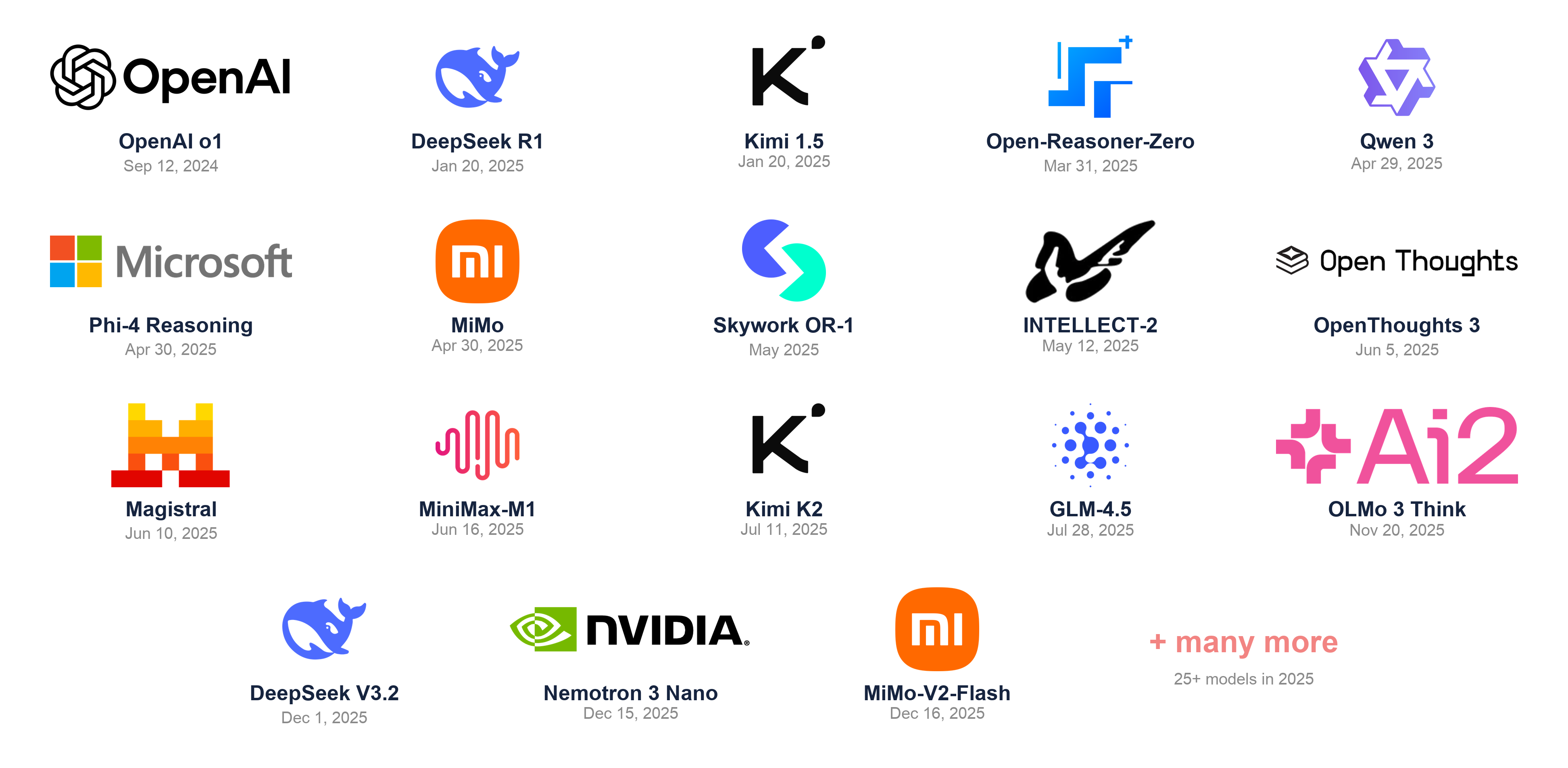
The reasoning model cambrian explosion

The reasoning model cambrian explosion

The research that came before

The key ideas behind RLVR aren’t new – they were explored before o1/R1 made them mainstream (and effective):

The models that followed these scaled up the methods, in a simpler approach, and shifted the focus of post-training.

Why does RL work now?

  • Stability is much more tractable: Still a first-class research problem (entropy collapse, long-horizon credit), but tooling and recipes are mature enough for widespread adoption
  • Base models are good enough: Multiple sources suggest RL reasoning training only became viable with models from ~2024 onwards – a capability floor was needed
  • Verifiable domains provide clean signal: Math and code give unambiguous rewards, avoiding the reward hacking problems of RLHF

This lecture

  1. The seminal models
  2. What we learned about them
  3. What recent history teaches us

DeepSeek R1 (Jan. 20, 2025): The catalyst

A surprisingly fast o1 replication.

R1-Zero: Pure RL on a base model. No SFT warm-start. Showed that large-scale RL alone induces chain-of-thought reasoning.

The full R1 recipe: Cold-start SFT → large-scale RL → distillation of smaller models.
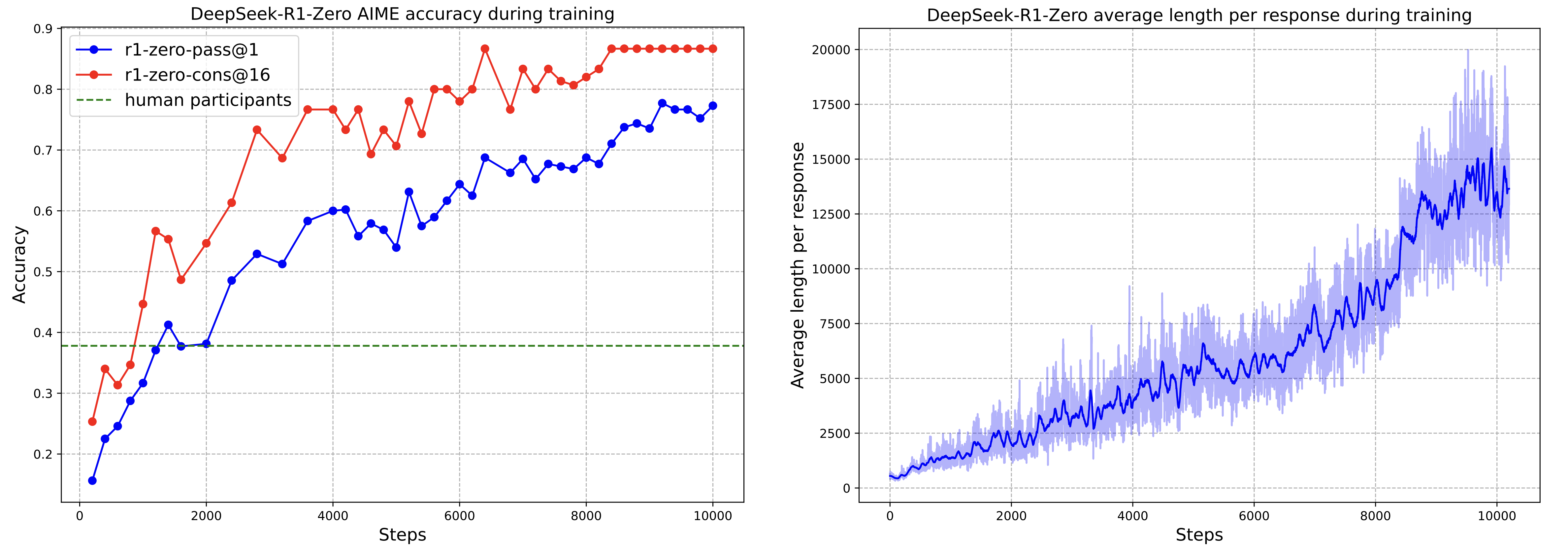
Training reward curve for DeepSeek R1-Zero showing emergent reasoning behavior.

Kimi 1.5 (Jan. 20, 2025): Scaling the curriculum

Kimi 1.5 landed in the same January wave as R1 and emphasized RL scale plus curriculum.

  • PPO/GRPO-style RL on Chinese and English reasoning data
  • Difficulty scheduling and online filtering to keep gradients useful
  • Progressive length extension to reduce overthinking while enabling long CoT
  • Detailed technical report, but no open-weight k1.5 release
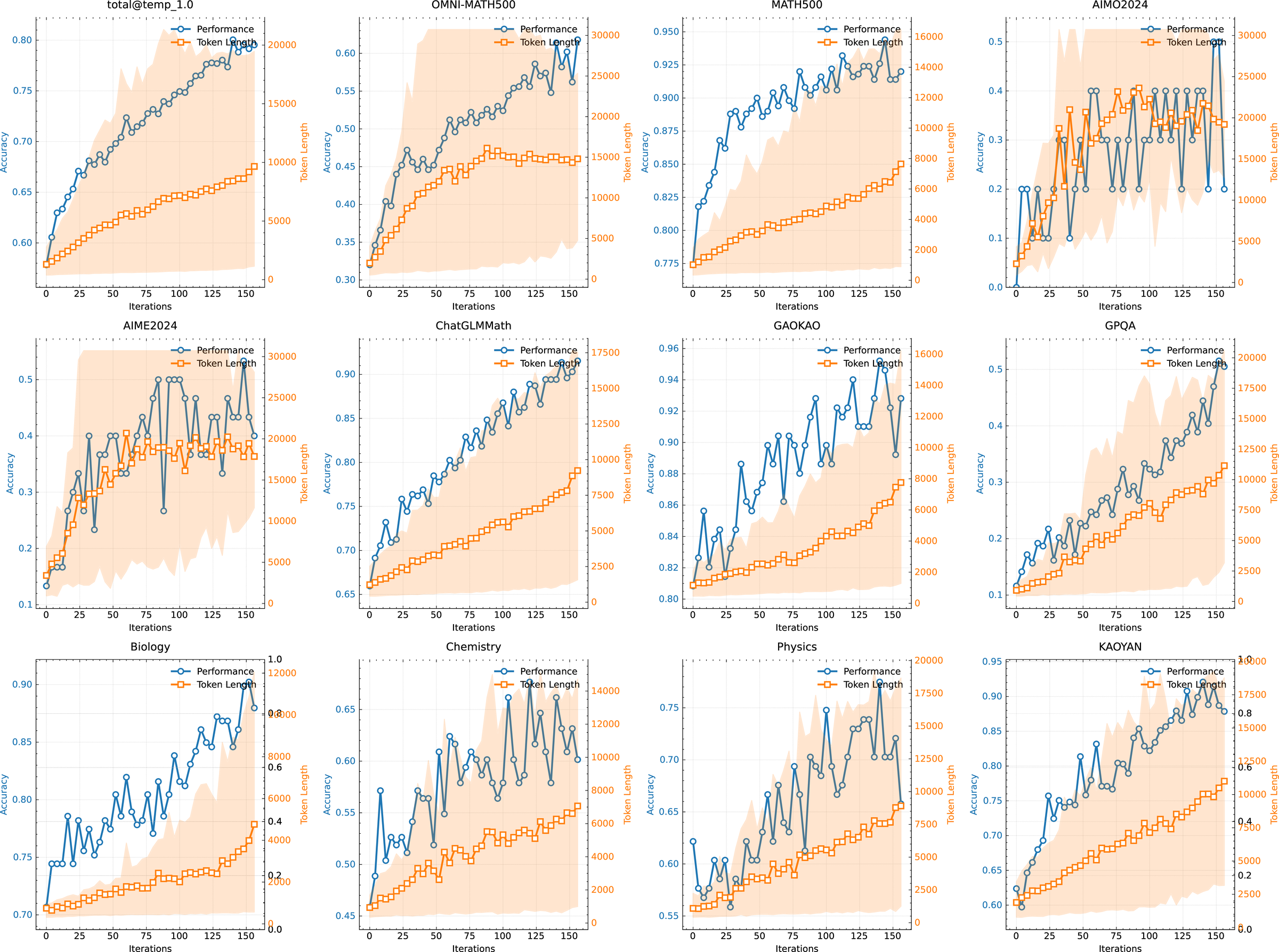
Kimi 1.5 RL training dynamics: accuracy and response length grow together across benchmarks.

Open-Reasoner-Zero (Feb. 18, 2025): The minimalist replication

First public dataset and code for an r1-style, base model RL run.

  • Fully open: training code, curated RL data, and model weights
  • Vanilla PPO with GAE (\lambda=1, \gamma=1) and simple rule-based rewards
  • No KL penalty
  • Mar. 31 expansion: easier scripts and 129k curated problems
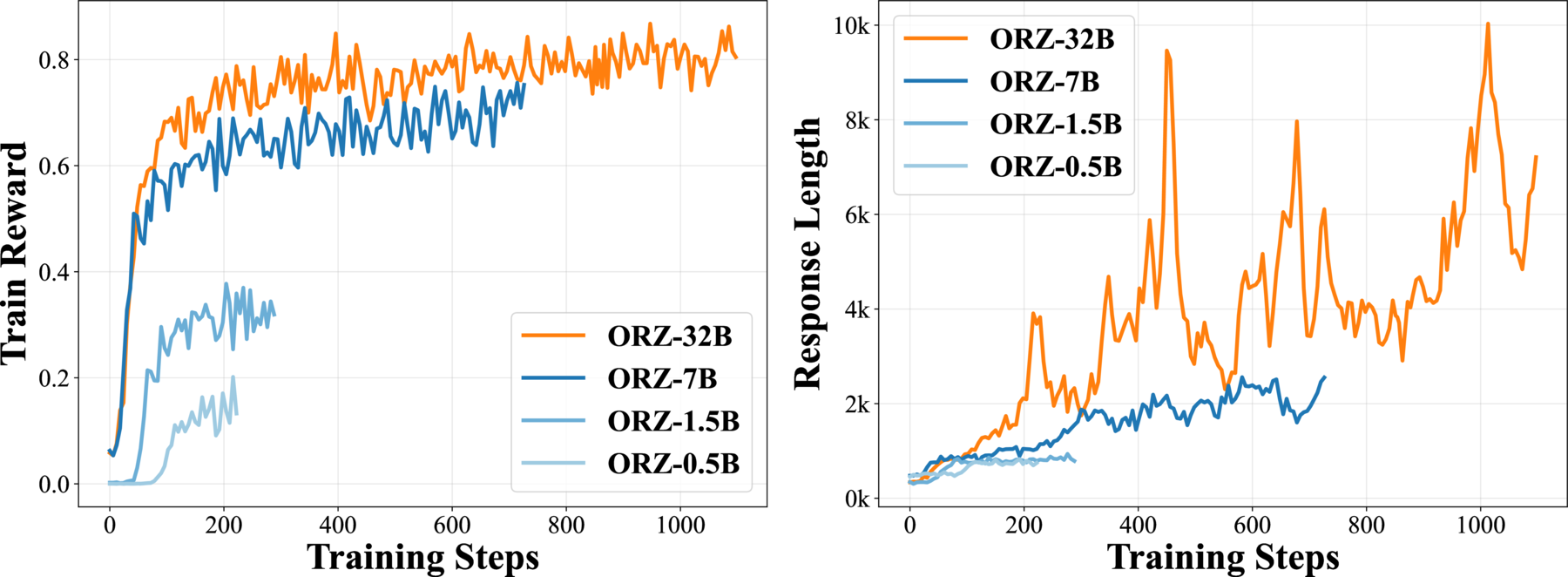
Open-Reasoner-Zero train-time scaling curves from the paper.

Qwen 3 (Apr. 29, 2025): Hybrid reasoners

New open weight standard (RIP Llama 4).

  • Toggleable thinking: /think and /no_think modes (most labs found this to be quite the training headache)
  • Thinking budget length controls
  • Large-model recipe mirrors the R1-style multi-stage pipeline
  • Lightweight models use strong-to-weak distillation: off-policy outputs, then on-policy teacher-logit matching

Llama-Nemotron (Bercovich et al., 2025) is another toggleable open-weights reasoner with released post-training data and training codebases, but a different recipe.
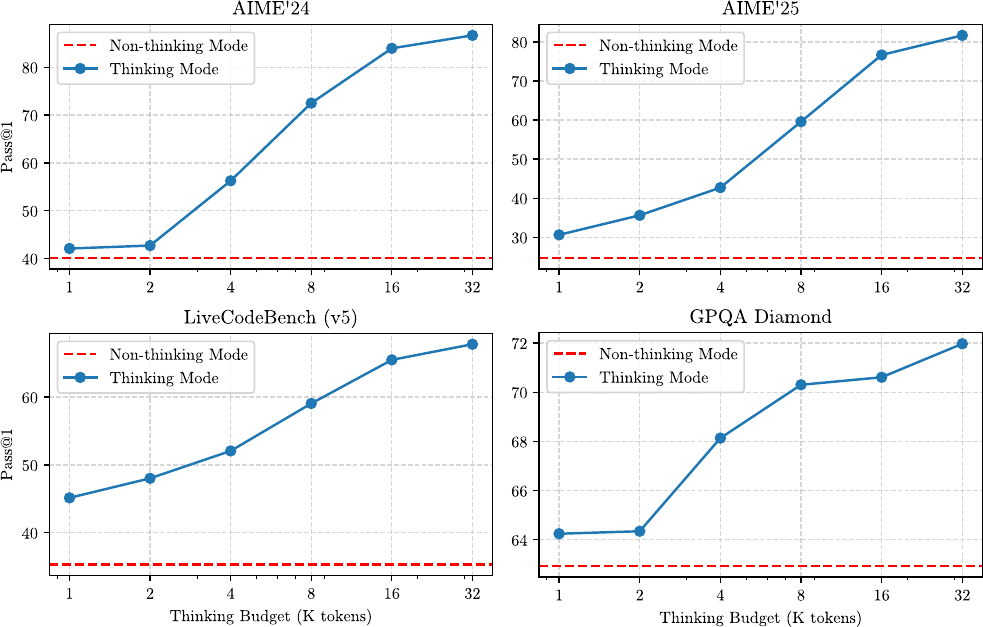
Qwen 3 performance curves under different thinking budgets from the paper.

MiMo (Apr. 30, 2025): End-to-end reasoning pipeline

Xiaomi reports the entire pipeline from pretraining through post-training.

Tweaks to a training recipe for reasoning:

  • Three-stage data mixing during pretraining (25T tokens)
  • Multi-Token Prediction (MTP) during pretraining
  • Multi-domain RL to prevent over-optimization on a single task type

One of the only open-weight reasoning models to release clear intermediate checkpoints within post-training!
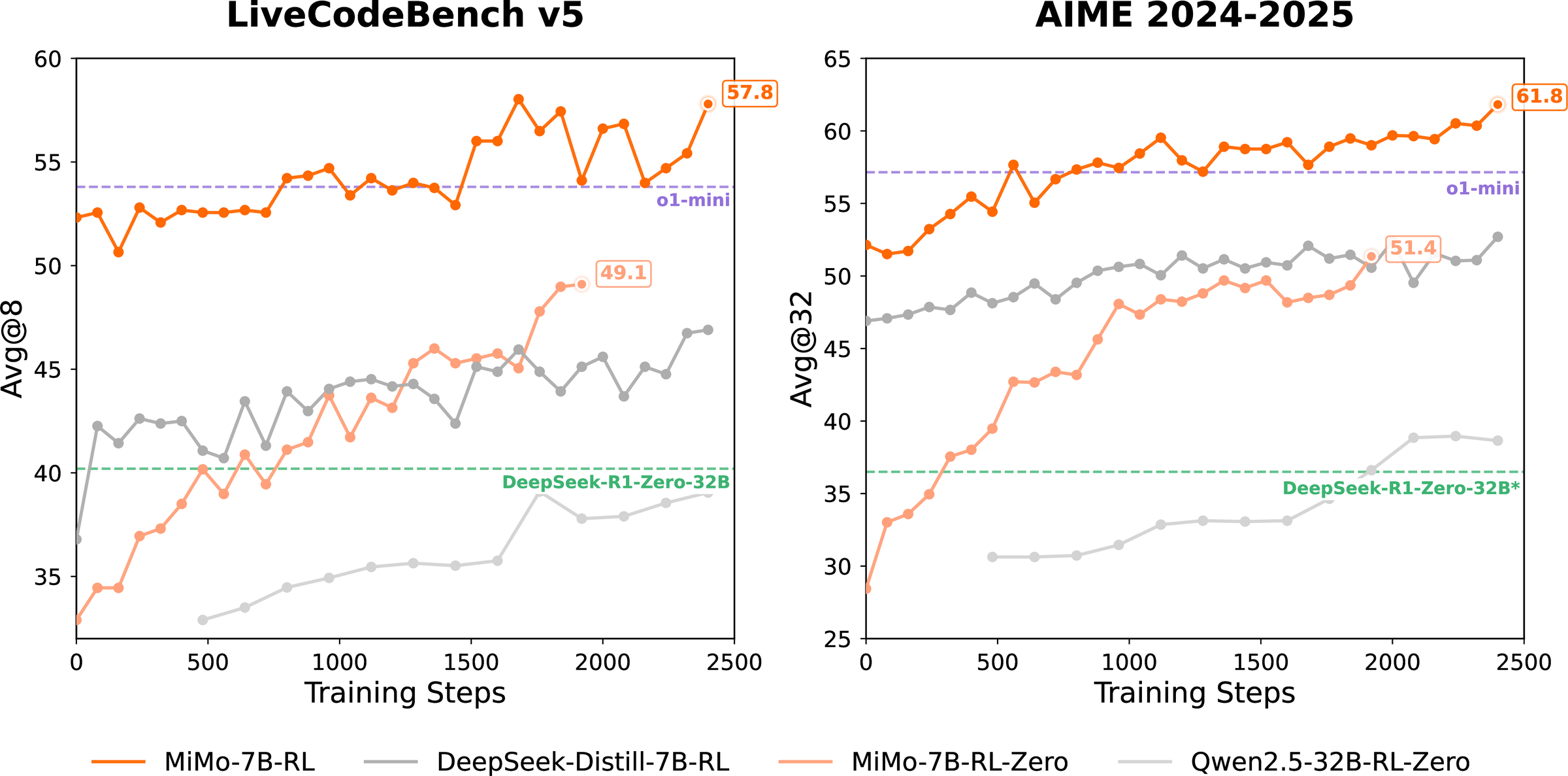
MiMo-7B-RL surpasses o1-mini and larger RL baselines on both code (LiveCodeBench) and math (AIME) -- reasoning-oriented pretraining sets the RL ceiling.
MiMo-7B-RL surpasses o1-mini and larger RL baselines on both code (LiveCodeBench) and math (AIME) – reasoning-oriented pretraining sets the RL ceiling.

OpenThoughts 3 (Jun. 5, 2025): SFT data recipes still matter

The foundational, open reasoning data (still quite strong)!

  • 1.2M public examples across math, code, and science
  • QwQ-32B traces, over 1,000 controlled data-pipeline experiments
  • OpenThinker3-7B reaches strong reasoning performance with SFT only

The community needs more investment in strong, open reasoning traces (and understanding what makes a good teacher).
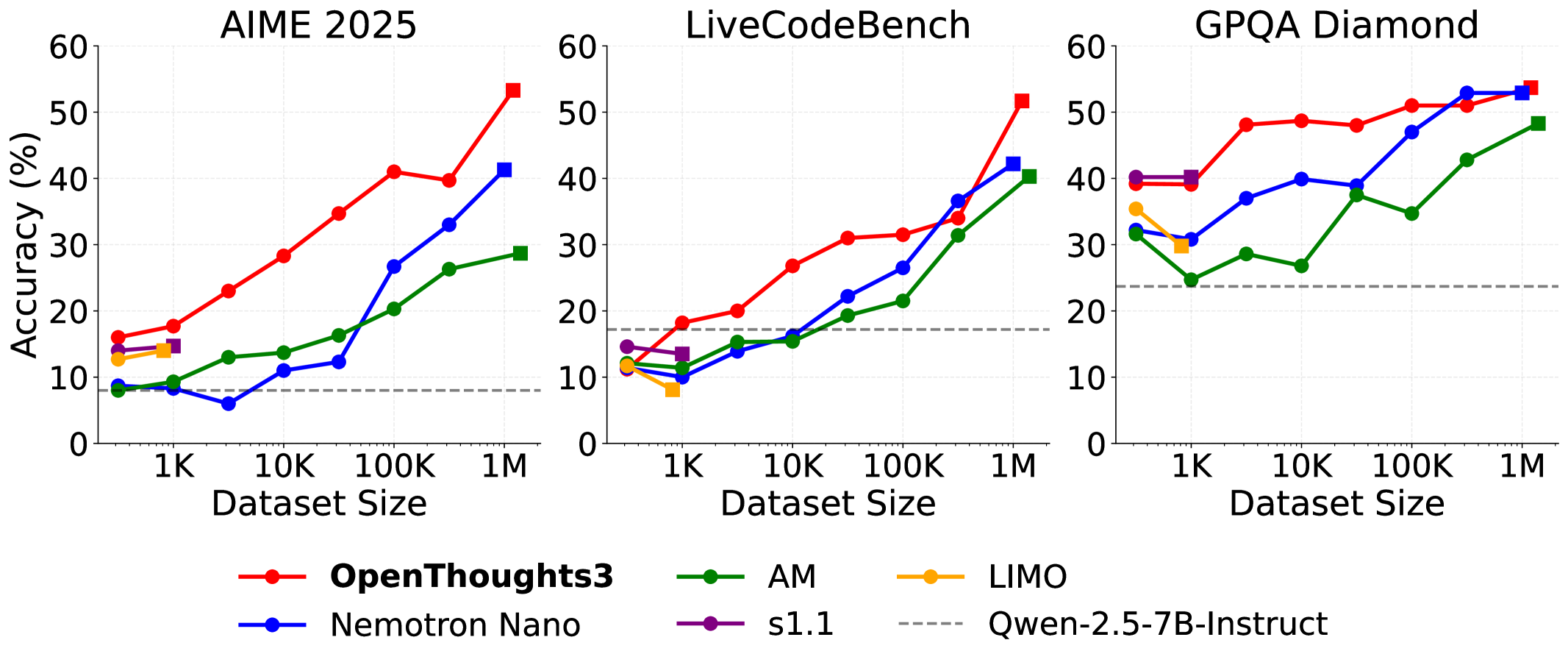
OpenThoughts3 scaling curves across AIME 2025, LiveCodeBench, and GPQA Diamond.

MiniMax-M1 (Jun. 16, 2025): A fun RL paper!

MiniMax M1’s paper really held the test of time. On top of the very popular models:

  1. CISPO clips importance-sampling weights instead of dropping high-update tokens. This sort of algorithm has been lasting.
  2. Introduced the now famous FP32 LM head inference-training mismatch plot.
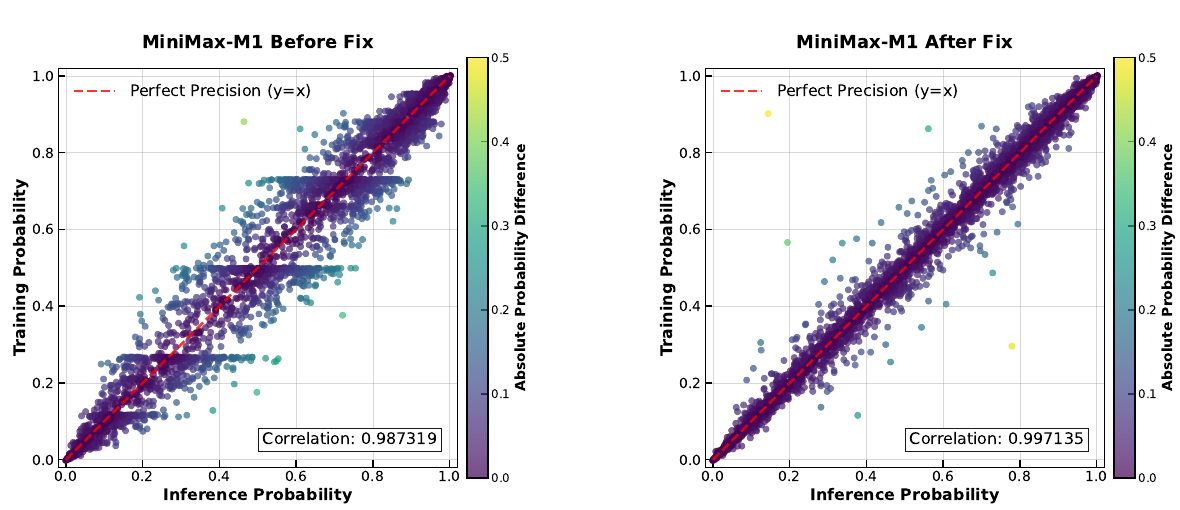
Per-token probabilities from the training engine vs. the inference engine, before and after the fix. Running the LM head in low precision makes the two diverge -- a hidden train/inference mismatch that destabilizes RL -- and upcasting just the LM head to FP32 realigns them.
Per-token probabilities from the training engine vs. the inference engine, before and after the fix. Running the LM head in low precision makes the two diverge – a hidden train/inference mismatch that destabilizes RL – and upcasting just the LM head to FP32 realigns them.

GLM-4.5 (Jul. 28, 2025): Reasoning broadens into agentic work

GLM-4.5 report was one of the early ones to focus on agentic behaviors. Otherwise, it represented “yet another” very strong, open Chinese model through the summer wave.

  • 355B total parameters, 32B active
  • Thinking and direct-response modes
  • Expert-model iteration plus RL for agent, reasoning, and general chat skills
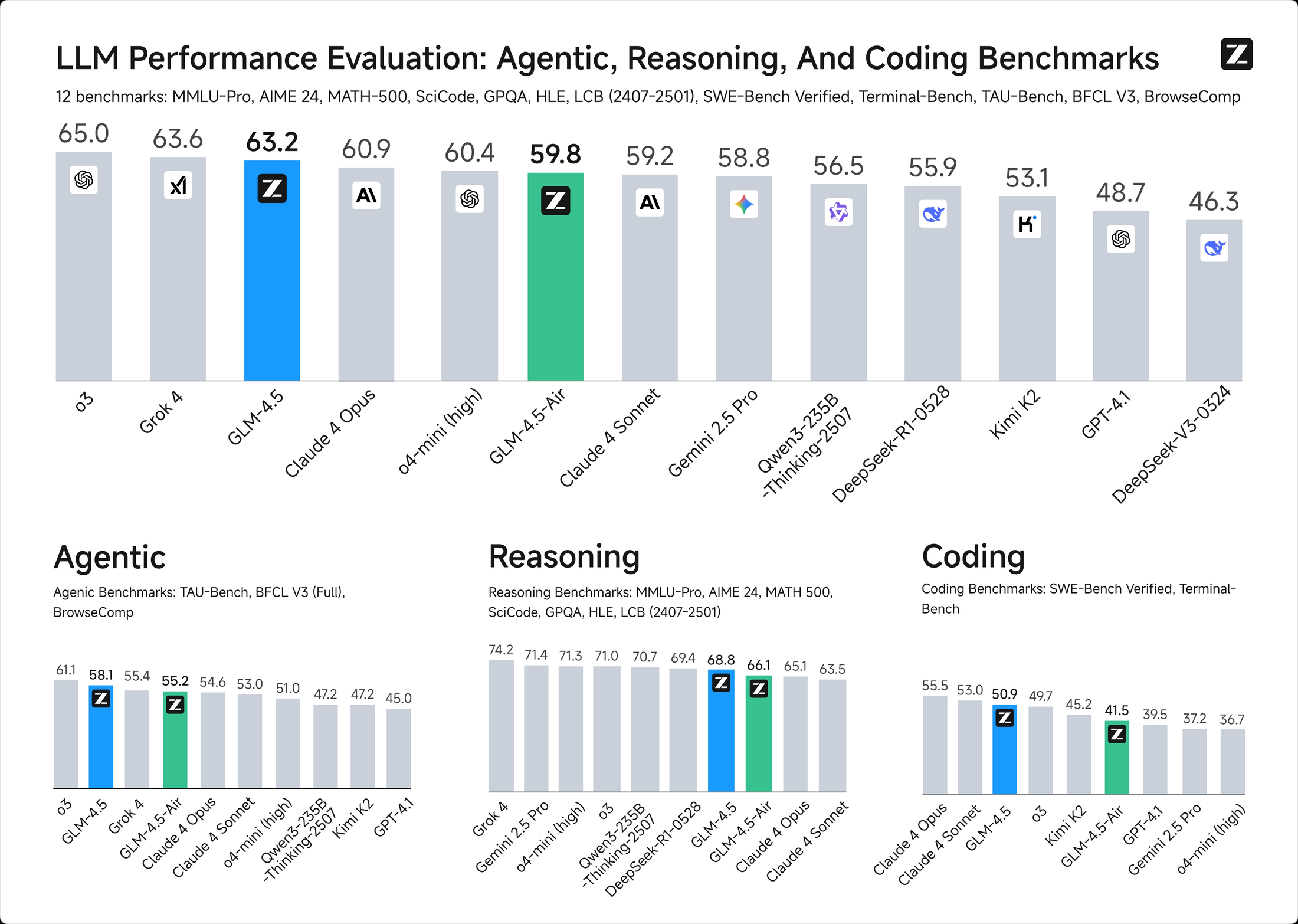
GLM-4.5 average performance on agentic, reasoning, and coding benchmarks.

Olmo 3 Think (Nov. 20, 2025): The fully open reasoning model

The most comprehensive open documentation of a reasoning model lifecycle.

Releases: stages, checkpoints, data, infrastructure, hyperparameters.

Interesting DPO findings and more fun stuff. See this talk for more.
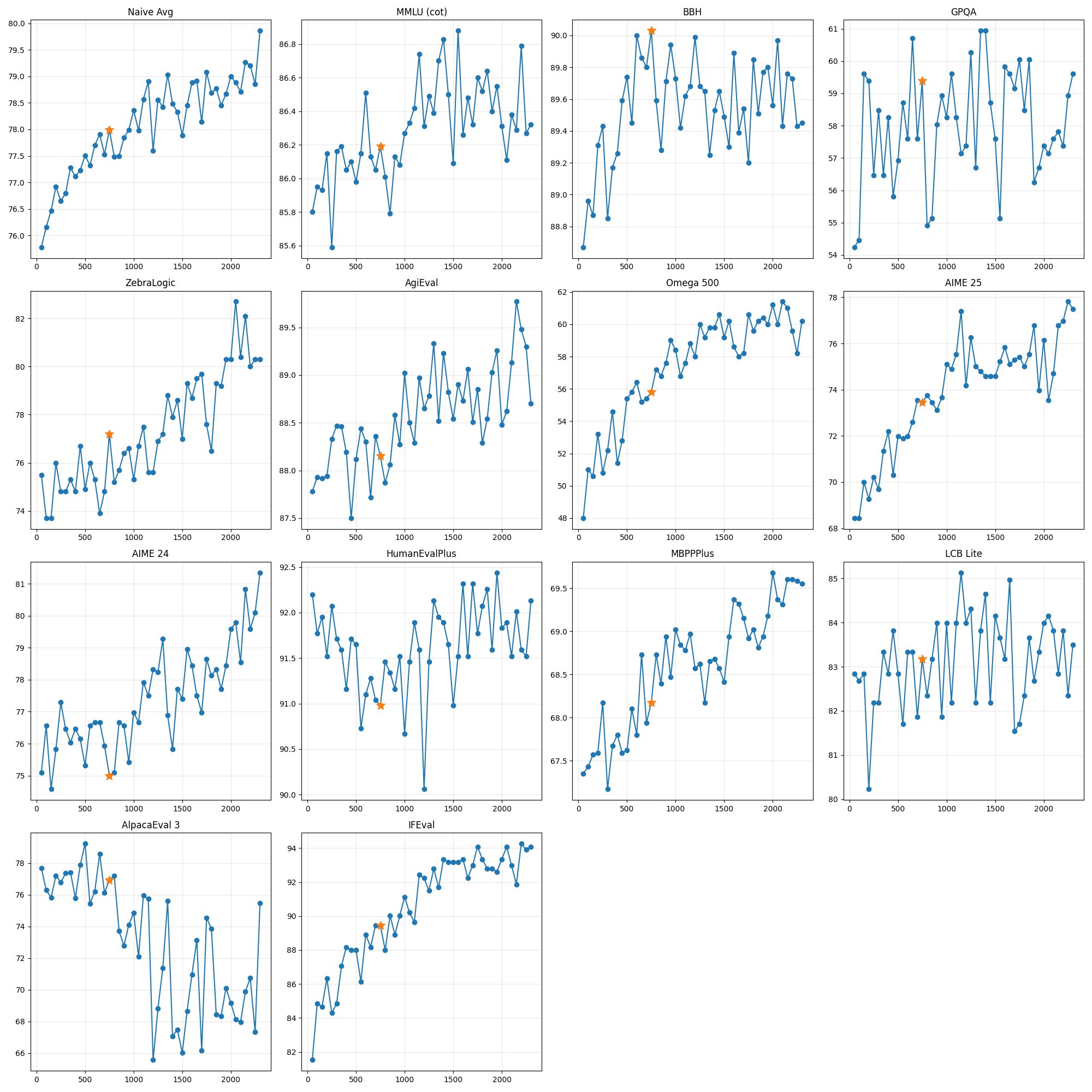
Olmo 3.1 Think extended RL training lifecycle from the model report.

DeepSeek V3.2 (Dec. 1, 2025): Reasoning becomes agentic

DeepSeek V3.2 pushes the R1 recipe into tool-use and agent environments.

  • Open-weight MoE successor to V3.2-Exp
  • V3.2 integrates thinking directly into tool use, no longer distinct reasoning models
  • Speciale variant targets maximum reasoning performance
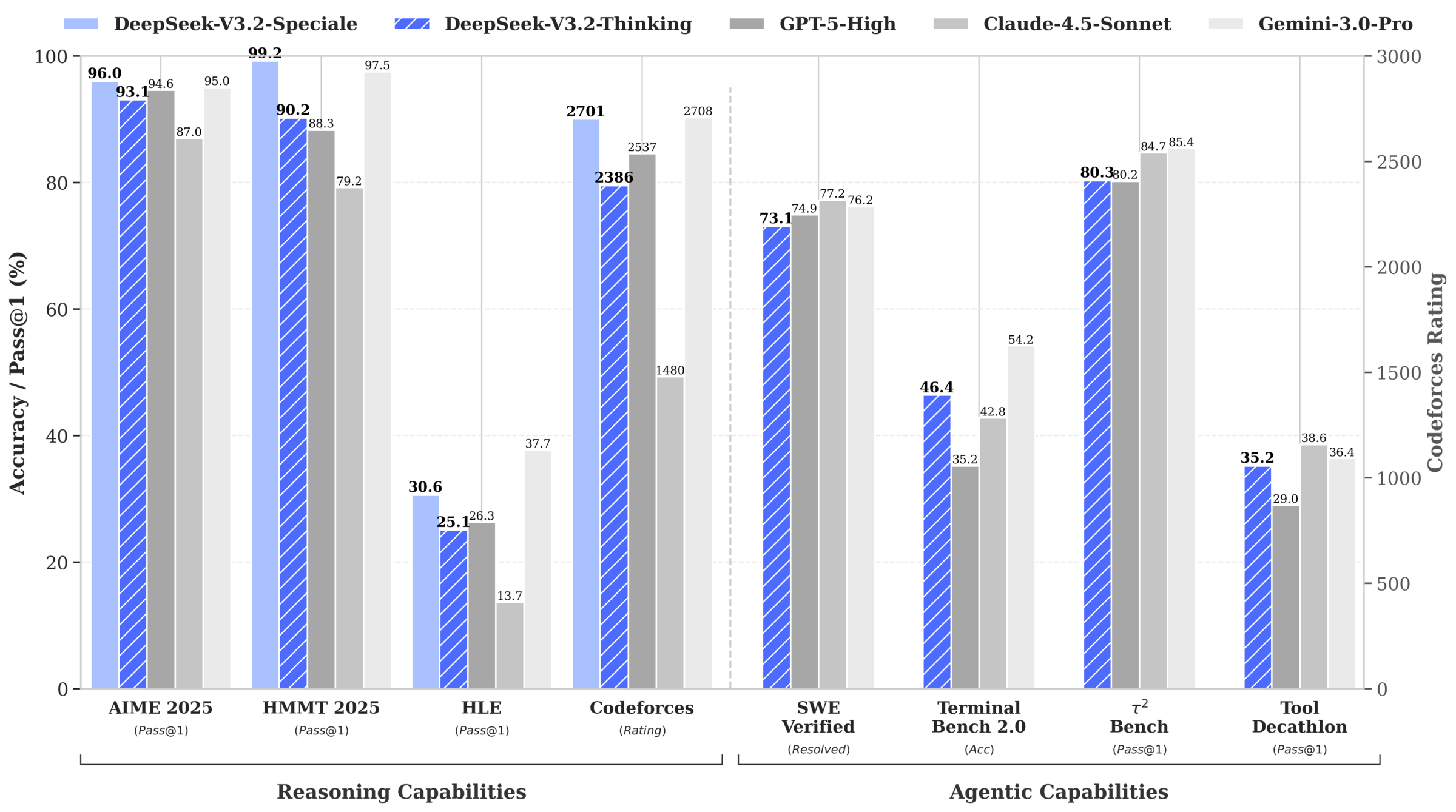
DeepSeek V3.2 benchmark chart comparing reasoning and agentic capabilities.

Nemotron 3 Nano (Dec. 15, 2025): Efficient agentic reasoning

Another very open (and American) model, which led into stronger American open-weight models in 2026.

  • 31.6B total parameters, roughly 3.2B active per forward pass
  • Hybrid Mamba-Transformer MoE architecture
  • Post-trained with SFT, multi-environment RLVR, and RLHF
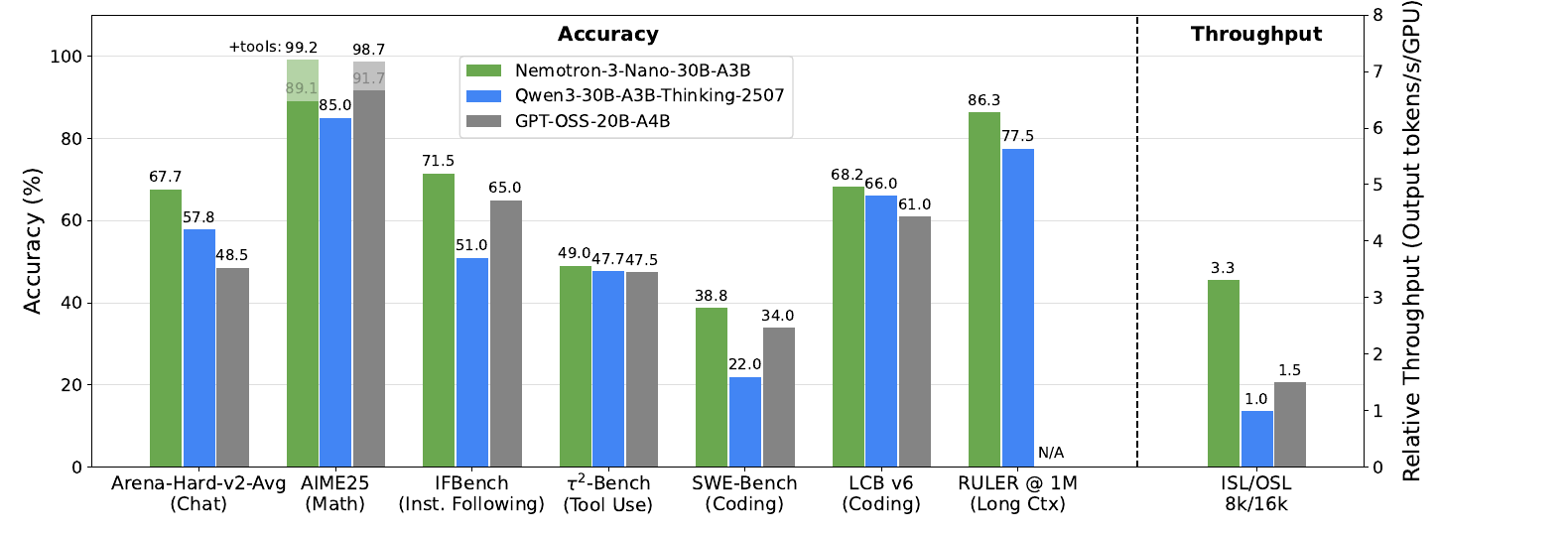
Nemotron 3 Nano accuracy and throughput comparisons from the technical report.

MiMo-V2-Flash (Dec. 16, 2025): Distilling many teachers into one

The notable contribution is in post-training: Multi-Teacher On-Policy Distillation (MOPD).

  • Train a specialist teacher per domain (math, code, search, reasoning), then distill them into a single student
  • The student learns from dense, token-level rewards, not just sequence-level outcome rewards – more sample-efficient, and it matches its strongest teacher in every domain
  • Underlying model is a 309B/15B MoE built for fast rollouts, but the recipe is the story here
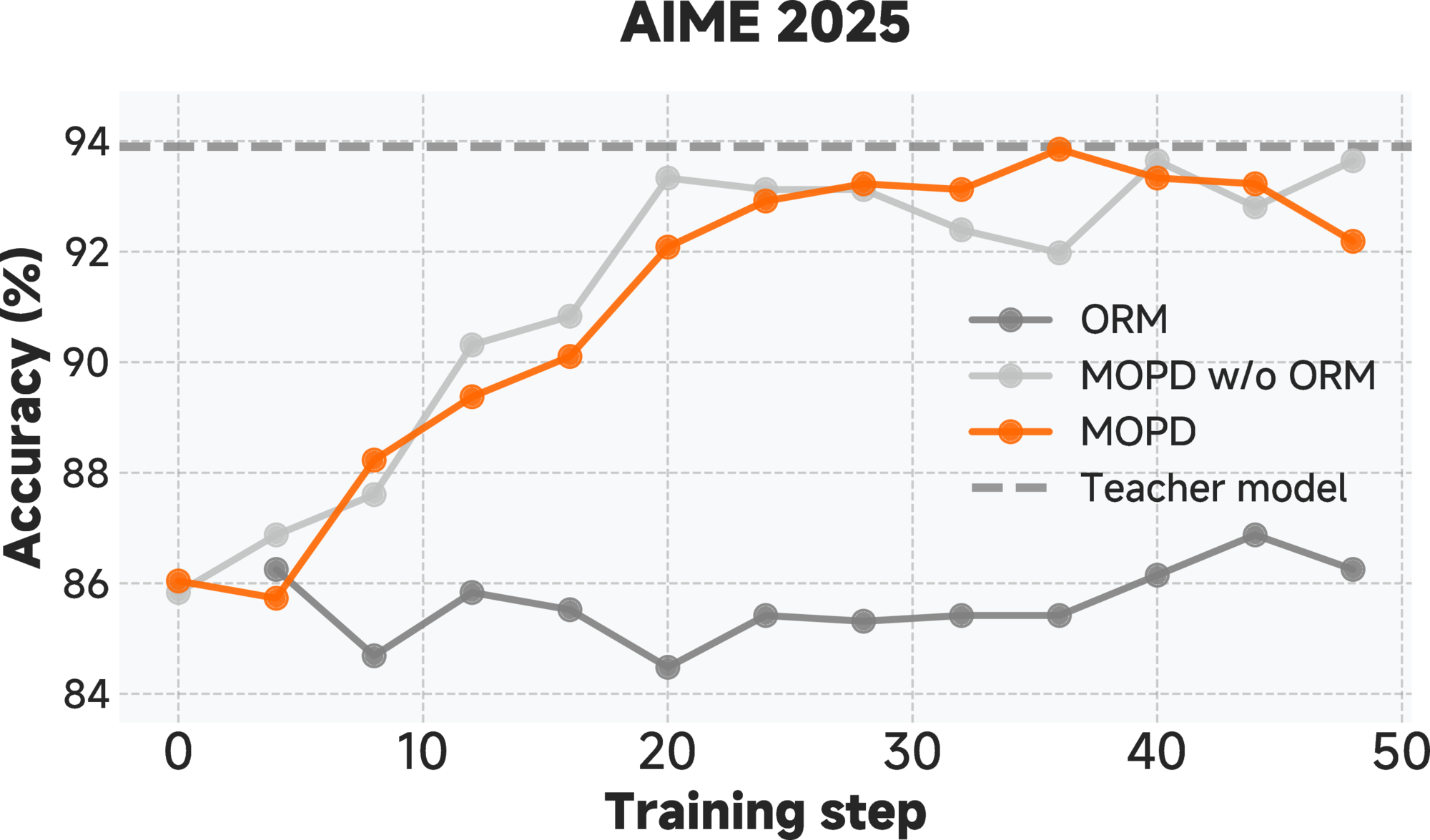
MOPD post-training: dense token-level reward from domain teachers lifts the student to teacher-level accuracy, where sequence-level ORM stalls.

Recent American open models

NVIDIA Nemotron 3 Super (Mar. 10, 2026)

  • 120B/12B MoE; LatentMoE, MTP, native NVFP4 pretraining
  • Fully open: checkpoints, training data, and recipes

Arcee Trinity-Large-Thinking (Apr. 1, 2026)

  • Frontier reasoning model tuned for long-horizon, multi-turn tool use
  • Apache 2.0 weights; SFT + RL pipeline

Recent Chinese open models

  • Kimi K2.5 (Jan. 27, 2026) → K2.6 (Apr. 20, 2026): native multimodality and agent swarms, then stronger long-horizon coding
  • GLM-5 (Feb. 12, 2026) → GLM-5.1 (Apr. 7, 2026): agentic engineering, then longer and more stable autonomous runs
  • DeepSeek V4 Preview (Apr. 24, 2026): open Pro and Flash models, dual reasoning modes, efficient architecture innovations, and 1M-token context

The frontier moved fast – from “reasoning model” to long-horizon, tool-using agent substrate.

What the landscape tells us

  1. RL basics were quickly replicated in open-source codebases and data
  2. The shift to agentic models followed very quickly from math/code reasoning tasks. Models like Olmo 3 (which I built and know was a bit late) stand out even more here
  3. Substantial innovation at the model layer to make long-context inference more efficient, especially from Chinese labs
  4. Lots of lasting fundamentals (FP32 LM head, CISPO style losses, etc.) emerged very quickly but took meaningful tinkering to converge

Common implementation patterns

Recipe decisions (1/4)

  1. Offline difficulty filtering – pre-sample N completions/prompt, keep prompts at ~20-80% pass rate (where the gradient lives). Seed-Thinking 1.5 (Seed et al., 2025), Open-Reasoner-Zero (Hu et al., 2025), Phi-4 Reasoning (Abdin et al., 2025), INTELLECT-2 (Team et al., 2025), MiMo (Xia et al., 2025), Skywork OR-1 (He et al., 2025), Olmo 3 (Olmo et al., 2025)
  2. Online filtering and curriculum – skip prompts now too easy/hard; save harder problems for later. Kimi 1.5 (Team et al., 2025), Magistral (Mistral AI, 2025), Llama-Nemotron (Bercovich et al., 2025), INTELLECT-2 (Team et al., 2025), MiMo (Xia et al., 2025)
  3. Zero-gradient filtering + active sampling – drop groups where all G completions pass or fail (advantage 0), then refill the batch. Olmo 3 (Olmo et al., 2025). Makes loss nice and very stable!
  4. KL penalty: dropped, now creeping back – single-turn math RLVR usually sets \beta=0 (verifiable rewards resist over-optimization). Magistral (Mistral AI, 2025), Open-Reasoner-Zero (Hu et al., 2025), Skywork OR-1 (He et al., 2025) But long-horizon, off-policy agentic training is reviving a KL/reference term for stability – e.g. Cursor Composer 2.
  5. Relaxed / asymmetric clipping – widen the upper clip bound to keep exploratory updates (DAPO (Yu & others, 2025)). Magistral (Mistral AI, 2025), INTELLECT-2 (Team et al., 2025)

Recipe decisions (2/4)

  1. CISPO – clip importance-sampling weights instead of masking high-update tokens (MiniMax-M1 (MiniMax, 2025)); ScaleRL (Khatri et al., 2025) picked it as the best loss in their scaling study. Recall importance sampling and clipping from Lecture 3.
  2. Normalization choices – how you average advantages and loss quietly changes the objective. Normalize advantages across the whole batch, not per prompt group, so a few easy/hard prompts don’t dominate (Magistral (Mistral AI, 2025), MiMo (Xia et al., 2025)); average loss over total tokens, not per sequence, to remove a length bias (Dr. GRPO (Liu et al., 2025)). See the per-token vs. per-sequence loss-aggregation deep dive in Lecture 4.
  3. Format rewards – reward valid <think> blocks and extractable answers; usability, not correctness. DeepSeek R1 (Guo et al., 2025), Open-Reasoner-Zero (Hu et al., 2025), Magistral (Mistral AI, 2025), Skywork OR-1 (He et al., 2025)
  4. Language consistency rewards – penalize language switching inside a trace. DeepSeek R1 (Guo et al., 2025), Magistral (Mistral AI, 2025). Models used to switch to Chinese or French while reasoning.
  5. Length control – progressive length extension – i.e. the maximum length of training, which rewards concise thinking (Kimi 1.5 (Team et al., 2025)); small length penalty (INTELLECT-2 (Team et al., 2025)); overlong filtering for throughput.

Recipe decisions (3/4)

  1. Inference is the bottleneck – long, variable completions; Olmo 3 learner GPUs idle ~75%, 5-14x more inference than training compute.
  2. Off-policy / async updates – actors generate continuously, the learner consumes; rollouts go slightly stale but throughput jumps. Seed-Thinking 1.5 (Seed et al., 2025), INTELLECT-2 (Team et al., 2025) – deep dive: Olmo 3 slides, recording
  3. Test-time scaling – majority voting (DeepSeek R1 (Guo et al., 2025), Phi-4 (Abdin et al., 2025)); selector model (DeepSeek-GRM (Liu et al., 2025)); the pass@K vs pass@1 gap shows the headroom.
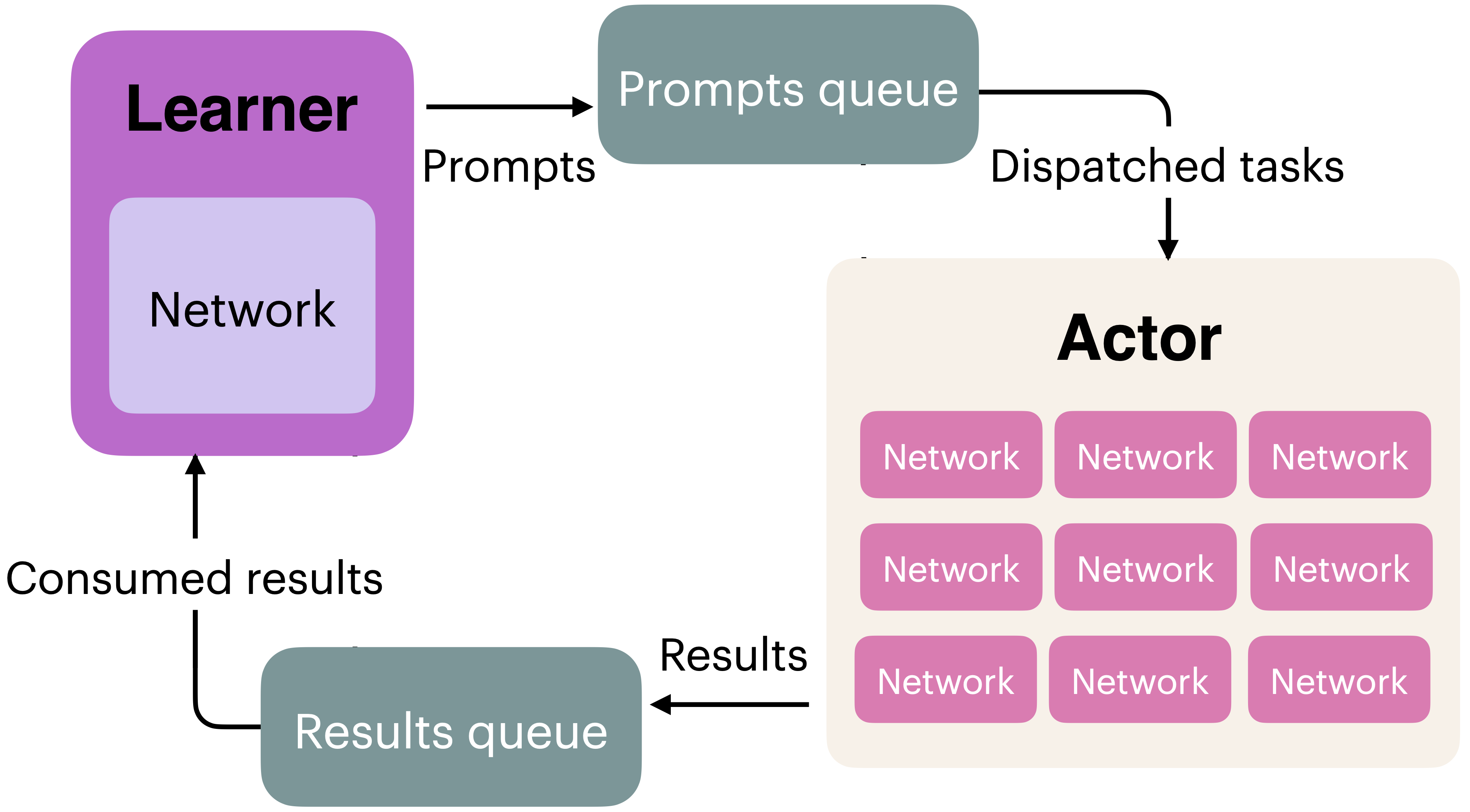
Distributed RL training infrastructure.

Recipe decisions (4/4)

  1. Finding – text-only RL boosts multimodal – text reasoning RL after multimodal training improves vision tasks. MiMo-VL, Magistral (Mistral AI, 2025)
  2. Finding – midtraining sets the RL ceiling – the math/code share in pretraining bounds what RL can reach. MiMo (Xia et al., 2025)

Open questions

  • Is RL training discovering new capabilities, or eliciting what pretraining already learned?
  • How far can reasoning training go without better pretraining data? Pretraining does NOT seem dead.
  • Will agentic RL (tool use + reasoning) require fundamentally different recipes?
  • Can we systematically study the scaling properties of RL for reasoning? (Khatri et al., 2025)
  • In 1, 2, 5, and 10 years what does the balance of compute between pretraining and RL look like?

RL training libraries

  • slime – SGLang-native post-training framework for RL scaling; used for the GLM model line
  • SkyRL – modular full-stack RL library for LLMs, with async and multi-turn agent workflows
  • veRL – flexible, production-oriented RL training library from the HybridFlow work
  • OpenRLHF – Ray-based RLHF and RLVR training framework
  • TRL – Hugging Face post-training library with accessible trainer APIs
  • Open Instruct – Ai2’s open post-training recipes and research code

Course outline

  1. Introduction & Training Overview – Chapters 1-3
  2. IFT, Reward Models, Rejection Sampling – Chapters 4, 5, 9
  3. RL Theory – Chapter 6 (Part 1)
  4. RL Implementation & Practice – Chapter 6 (Part 2)
  5. Reasoning – Chapter 7
  6. Direct Alignment Algorithms – Chapter 8

Thank you

Questions and discussion welcome.

Nathan Lambert

rlhfbook.com | interconnects.ai

References (1/4)

Abdin, M., Agarwal, S., Awadallah, A., and others. “Phi-4-Reasoning Technical Report.” arXiv preprint arXiv:2504.21318, 2025.
Bercovich, A., Levy, I., Golan, I., and others. “Llama‑Nemotron: Efficient Reasoning Models.” arXiv preprint arXiv:2505.00949, 2025.
DeepSeek-AI. “DeepSeek-V3.2: Pushing the Frontier of Open Large Language Models.” 2025. [link]
GLM-4.5 Team. “GLM-4.5: Agentic, Reasoning, and Coding (ARC) Foundation Models.” 2025. [link]
Guha, E., Marten, R., Keh, S., and others. “OpenThoughts: Data Recipes for Reasoning Models.” arXiv preprint arXiv:2506.04178, 2025.
Guo, D., Yang, D., Zhang, H., Song, J., Zhang, R., et al.. “Deepseek-r1: Incentivizing reasoning capability in llms via reinforcement learning.” arXiv preprint arXiv:2501.12948, 2025.
He, J., Liu, J., Liu, C., and others. “Skywork Open Reasoner 1 Technical Report.” arXiv preprint arXiv:2505.22312, 2025.
Hoffman, M., Phan, D., dohan, Douglas, S., Le, T., et al.. “Training Chain-of-Thought via Latent-Variable Inference.” Thirty-seventh Conference on Neural Information Processing Systems, 2023. [link]
Hu, J., Zhang, Y., Han, Q., Jiang, D., Zhang, X., et al.. “Open-Reasoner-Zero: An Open Source Approach to Scaling Up Reinforcement Learning on the Base Model.” arXiv preprint arXiv:2503.24290, 2025.

References (2/4)

Kazemnejad, A., Aghajohari, M., Portelance, E., Sordoni, A., Reddy, S., et al.. “VinePPO: Unlocking RL Potential For LLM Reasoning Through Refined Credit Assignment.” 2024. [link]
Khatri, D., Madaan, L., Tiwari, R., Bansal, R., Duvvuri, S., et al.. “The art of scaling reinforcement learning compute for llms.” arXiv preprint arXiv:2510.13786, 2025.
Lambert, N., Morrison, J., Pyatkin, V., Huang, S., Ivison, H., et al.. “T\""ulu 3: Pushing Frontiers in Open Language Model Post-Training.” arXiv preprint arXiv:2411.15124, 2024.
Liu, Z., Wang, P., Xu, R., Ma, S., Ruan, C., et al.. “Inference-Time Scaling for Generalist Reward Modeling.” arXiv preprint arXiv:2504.02495, 2025.
Liu, Z., Liu, C., Gao, W., Liang, Z., Liu, T., et al.. “Understanding R1-Zero-Like Training: A Critical Perspective.” arXiv preprint arXiv:2503.20783, 2025.
LLM-Core Xiaomi. “MiMo-V2-Flash Technical Report.” 2025. [link]
MiniMax. “MiniMax-M1: Scaling Test-Time Compute Efficiently with Lightning Attention.” 2025. [link]
Mistral AI. “Magistral: Scaling Reinforcement Learning for Reasoning in Large Language Models.” 2025. [link]
NVIDIA. “Nemotron 3 Nano: Open, Efficient Mixture-of-Experts Hybrid Mamba-Transformer Model for Agentic Reasoning.” 2025. [link]

References (3/4)

Olmo, T., Ettinger, A., Bertsch, A., Kuehl, B., Graham, D., et al.. “Olmo 3.” 2025. [link]
OpenAI. “Introducing OpenAI o1-preview.” OpenAI Blog, 2024. [link]
Seed, B., Chen, J., Fan, T., Liu, X., Liu, L., et al.. “Seed1.5-Thinking: Advancing Superb Reasoning Models with Reinforcement Learning.” 2025. [link]
Synced. “Yann LeCun Cake Analogy 2.0.” SyncedReview, 2019. [link]
Team, P., Jaghouar, S., Mattern, J., Ong, J., Straube, J., et al.. “INTELLECT-2: A Reasoning Model Trained Through Globally Decentralized Reinforcement Learning.” 2025. [link]
Team, K., Du, A., Gao, B., Xing, B., Jiang, C., et al.. “Kimi k1. 5: Scaling reinforcement learning with llms.” arXiv preprint arXiv:2501.12599, 2025.
Xia, B., Shen, B., Zhu, D., Zhang, D., Wang, G., et al.. “MiMo: Unlocking the Reasoning Potential of Language Model--From Pretraining to Posttraining.” arXiv preprint arXiv:2505.07608, 2025.
Yang, A., Li, A., Yang, B., Zhang, B., Hui, B., et al.. “Qwen3 technical report.” arXiv preprint arXiv:2505.09388, 2025.
Yu, Q., and others. “DAPO: An Open-Source LLM Reinforcement Learning System.” arXiv preprint arXiv:2503.14476, 2025.
Zelikman, E., Wu, Y., Mu, J., and Goodman, N.. “STaR: Bootstrapping Reasoning With Reasoning.” Advances in Neural Information Processing Systems, 2022. [link]

References (4/4)

Zelikman, E., Harik, G., Shao, Y., Jayasiri, V., Haber, N., et al.. “Quiet-STaR: Language Models Can Teach Themselves to Think Before Speaking.” COLM, 2024.